
The two western states, already battling a raging pandemic, which has put their health infrastructure under severe strain, opened new fronts to tackle the fallout of the storm which is expected to make a landfall close to Mumbai on Wednesday. They are likely to be impacted most by the cyclone.

Mumbai and its adjoining areas were lashed by heavy showers on Tuesday, causing water-logging at a number of places, including railway tracks, which slowed the movement of trains and vehicles on roads.

Union Home Minister Amit Shah spoke to Chief Minister Uddhav Thackeray through video conference and took stock of the state's preparedness to tackle any eventuality, the latter's office said. 10 units of the National Disaster Response Force (NDRF) have been deployed in vulnerable districts, while six others have been kept on a stand-by, officials said.
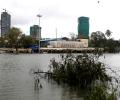
However, some areas in south Mumbai, which witnessed a record rain on Wednesday, were still water-logged, they said. The India Meteorological Department (IMD) has predicted moderate to heavy rainfall in the city and suburbs and intense showers in some parts of the Mumbai Metropolitan Region in next 24 hours.

The death toll in the massive explosion at an industrial unit in Dombivali township of the district has risen to six while 159 injured were undergoing treatment, a senior official said on Friday.

The home minister held a video conference with Chief Ministers of Gujarat and Maharashtra -- Vijay Rupani and Uddhav Thackeray respectively -- and Administrator of Dadra and Nagar Haveli and Daman and Diu, Praful Patel, and assured them all central help in view of the impending cyclone, an official statement said in New Delhi.

With the cyclone set to make landfall on Wednesday, Maharashtra and Gujarat activated their disaster response mechanism, deploying NDRF teams and evacuating people from areas likely to be hit.

The IMD has issued an orange alert for Mumbai, warning of very heavy rains at isolated places with strong winds on Monday as the very severe cyclonic storm Tauktae is likely to pass close to the Mumbai coast towards Gujarat.

The cyclone would bring light to moderate rains at most places and 'heavy to very heavy downpour' at some places on November 6.

The Santacruz observatory recorded 286.4 mm rainfall during the 24-hour period ending at 8.30 am on Wednesday, making it the fourth highest rainfall in Mumbai since 1974, an Indian Meteorological Department official said.

In an unprecedented measure, the Maharashtra government requested defence officials to arrange airlift of the stranded passengers of the 17412 Mahalaxmi Express.

The Mumbai civic body asked all schools to remain shut and to ensure that the students were sent back home safely.

Gale-force winds, heavy rainfall and high tidal waves swept the coastal belt of Kerala, Karnataka and Goa as Cyclone Tauktae hurtled northwards towards Gujarat on Sunday, leaving four people dead in Karnataka and two in Goa, damaging hundreds of houses, uprooting electricity poles and trees and forcing evacuation.

In just 10 days, the city received 864.5 mm rain, which is nearly equal to what it gets in an entire month.

The Indian Meteorological Department, meanwhile, warned of intense spell of 30 to 50 mm rainfall per hour with strong winds in Mumbai and suburban areas.

No immediate relief appears in sight as the India Meteorological Department issued a red alert for six districts which have been already pounded by downpour, forecasting "extremely heavy" rainfall and recommending preventive actions.

'Drought in the 1990s was essentially the drought of a poor India.' 'This 2016 drought is of a richer and more water-guzzling India.' 'The severity and intensity of the drought is not about lack of rainfall.' 'It is about the lack of planning and foresight, and criminal neglect.'

Prime Minister Narendra Modi spoke to Chief Minister Sarbananda Sonowal over phone and discussed about the prevailing condition on Monday.

Four people have died including one each in Delhi, Karnataka, Punjab and Maharashtra.

Cyclone Nisarga slammed Maharashtra coast with wind speeds of up to 120 kmph, making landfall at 12.30 pm at Alibaug near Mumbai. The process was completed by 2.30 pm, a senior India Meteorological Department official said. Alibaug witnessed wind speeds of up to 120 kilometres per hour. It weakened into a 'deep depression' late on Wednesday evening, the IMD said.
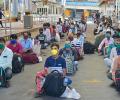
Official figures say 1.8 lakh workers have returned home to Bihar. Unofficially, however, that figure is said to have crossed 3 lakhs. Can Bihar cope?

Life in Mumbai was on Wednesday slowly coming back on tracks as rains subsided and hundreds of stranded commuters headed home with the partial resumption of suburban train services.

Orissa learnt its lessons from previous cyclones, particularly the 1999 super cyclone, whereas Uttarakhand has failed to do so from any of the previous natural calamities that hit the state, says Dinesh C Sharma.
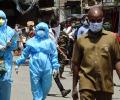
'Predictions are that numbers will continue to rise till May end and maybe in the first half of June will be our peak.'

The Union Health ministry put the number of positive cases at 82, eight more since Thursday night, which includes the woman and a 76-year-old man from Karnataka who became the country's first coronavirus fatality besides 17 foreign nationals, Health Ministry officials said.
 © 2026 Rediff.com - Advertise with us - Disclaimer - Privacy Policy - Sitemap - Feedback - About us - Terms of use - Grievances